Dr Marta Lonnie, The Rowett Institute, University of Aberdeen;
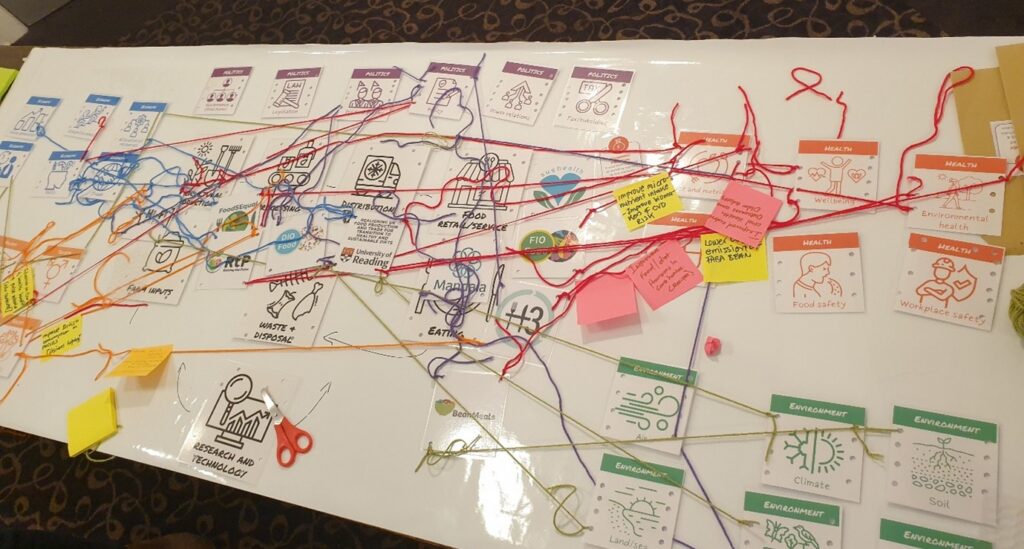
Imagine a whiteboard covered in colourful woolly string, sticky notes, and cards scattered across food system domains. That was the scene at the 2024 TUKFS Early Career Researchers conference in Sheffield. We gathered to map out the UK food system together – and in doing so, it became clear that the system itself looked just like the challenge we face: interconnected, overwhelming, and tough to tackle.
It was also the moment I realised something had quietly shifted in how I was thinking, not just about food systems, but about research itself.
The discipline that taught me to look away
Most of us who have been through traditional academic training have been shaped, often without realising it, by a powerful implicit instruction: narrow your scope! Focus your research question. Control your variables. Stay in your lane. Define your discipline and defend its boundaries. This is not bad advice – rigour matters – but it comes with a cost.
For years, I learned to zoom in. To look at parts, not wholes. To measure what was measurable and treat everything else as noise. My training, like most, was built on a reductionist logic: take a complex problem, break it into manageable components, study each one carefully, and trust that the sum of the parts will eventually add up to an understanding of the whole.
Our current approach to complex social problems tends to be linear and siloed: identify a symptom, select an intervention, deliver it within departmental boundaries, measure short-term outputs. Obesity becomes weight management classes. Poverty becomes crisis grants. Unemployment becomes employability workshops. These responses are not wrong, but they are just tip-of-the-iceberg thinking. Food systems thinking, by contrast, asks us to go deeper: to design actions that influence the underlying structures and feedback loops that drive problems in the first place. Donella Meadows called it moving from events to patterns of behaviour to systems structure to mental models. It is harder, slower, and requires us to hold much more complexity at once. But it is where the real leverage lives.
The Transforming UK Food Systems programme gave me permission – and more than that, a structure, a mentor and a community – to start thinking differently. To zoom out. To ask not just “what is happening in this part of the system?” but “what underlying structures are driving the patterns we keep seeing?” It was the first time in my research career that breadth was not a liability to be apologised for, but the entire point.
That reorientation was evident at the Sheffield conference. The tangled string was not a failure of method. It was an honest picture of a complex adaptive system, drawn by researchers who were finally looking at it as a whole. The question was: what do we do with that picture? How do we help others – policymakers, health boards, community organisations, students – navigate that complexity without either drowning in it or retreating into the comforting fiction that a single targeted intervention will fix it?
That question became the Bridge-ACT toolkit. The Bridge-ACT Toolkit was developed to fill a genuine gap: there are very few practical, accessible tools that bring non-academic stakeholders – local authority planners, health board staff, community organisations, policymakers – into a room and support them to think about food challenges as interconnected systems rather than isolated problems. The toolkit is built around a richly illustrated food system map – drawn by artist Hannah Mumby and conceptually informed by the food system framework of Parsons, Hawkes and Wells (2019) – and a structured workshop format that guides diverse groups through identifying the structural drivers of a food-related problem, locating leverage points, and designing interventions that go beyond treating symptoms.
In Scotland, this has particular relevance: local authorities and Health Boards are now required to produce local Good Food Nation Plans under the Good Food Nation (Scotland) Act 2022, yet many lack a structured process for doing so in a way that genuinely reflects food system complexity. Bridge-ACT offers exactly that – a facilitated, visually engaging, non-technical entry point into whole system thinking that works as well in a council chamber as it does in a research seminar room. You can see it in action in this short film of our workshop with the Aberdeen City Council: Visualising Change — Systems Thinking for Strategic Food System Planning.
But this blog is not really about the toolkit. It is about what happened to me – and to the team – in the process of making it.
What happens when you trust an Early Career Researcher with a budget
The Bridge-ACT project was funded through the TUKFS Annual Synergy Fund, amounting to £40,000. By research funding standards, this is modest. By early career researcher standards, it was transformative – not primarily because of what we built, but because of what we had to do to build it.
There is a gap in research careers that almost nobody names directly. It sits between the end of a PhD or postdoctoral position and the beginning of independent research leadership, and it is not a gap in knowledge or publications. It is a gap in operational experience. In being the person responsible for the decisions, the relationships, the timeline, the money, and the outcomes.
No PhD programme teaches you this, as we were always delivering into someone else’s grant. And yet funders, institutions, and hiring panels all expect it to have materialised somehow by the time you apply for your first independent award. The Bridge-ACT project was the first time I was not supporting a senior researcher’s project. I was leading one! And the difference was everything.
Here is what that actually looked like:
- Navigating institutional procurement for the first time
Commissioning a freelance illustrator seemed straightforward – until I learned that my university mandates a complex supplier onboarding process, an intellectual property agreement, a purchase order number, and a three-week approval chain. I’ve helped with grants before, but I’d never actually initiated one. The difference was eye-opening.
- Hiring and supervising a research assistant
This meant writing a brief, conducting a selection process (including a job interview!), managing expectations, giving feedback on work in progress, and – for the first time – being the person whose name is on the final sign-off. We also made a deliberate choice to hire our web developer, Fariha, as an undergraduate student through the Aberdeen Software Factory. She brought fresh thinking and flexibility to an iterative development process; we got a digital tool that evolved with the project rather than being fixed at the outset. She got paid, gained real project experience, and left with something tangible in her portfolio. It felt like the right way to pass the baton – if we had benefited from being trusted early, the least we could do was extend that same trust one step further down.
- Managing a budget end-to-end
Not as a line on someone else’s spreadsheet, but as the person who decides how to allocate limited resources across competing needs, tracks expenditure, and explains variances to a programme officer. Financial management is a learned skill. You cannot learn it without being given money to manage.
- Reporting to funders and being accountable
Writing progress reports when things are on track is easy. The real learning comes when a deliverable shifts, a timeline slips, or a planned approach fails. Communicating that honestly – taking responsibility, explaining your reasoning, proposing a path forward – is a skill that only develops through practice under real conditions.
- Coordinating a team across seven institutions
Nine ECRs, seven universities, a local authority partner, a freelance artist, and a web developer – all facing various institutional constraints, differing email response times, and diverse ideas of what counts as “urgent.” Truly collaborative, interdisciplinary work is complex in ways that joint-authored papers just don’t fully capture.
- Presenting and advocating publicly – as the lead
There is a qualitative difference between presenting your contribution to someone else’s project and standing in front of the Aberdeen City Council, the NIHR, and a TUKFS annual conference audience to present work that is yours to own. The preparation is different. The confidence it builds is different. And the professional identity it reinforces is different.
None of these things appear in a publications list. None of them would be visible in an academic CV in the conventional sense. But every single one of them is assessed, implicitly or explicitly, in every research leadership application, every large grant review, every academic interview panel.
When funders ask early career researchers to demonstrate that they can manage a team, navigate institutional systems, and deliver against a workplan – they are asking for evidence of exactly these experiences. And the only way to accumulate that evidence is to actually do it, with real money, real partners, real consequences, and real accountability.
Being Trusted Is Not a Small Thing
There is something that sits underneath all of this that I want to be explicit about, because it is easy to overlook when we talk about capacity-building in abstract terms.
Being trusted with a project – even a £40,000 one – is a signal. It says, “We believe you are ready.” Not ready to assist. Not ready to contribute. Ready to lead. Professional identity isn’t just about competence. It’s shaped by being trusted and by acting as if that trust is deserved. The Bridge-ACT project gave our team that experience, and I believe it subtly shifted how each of us perceives what we’re capable of – in a way that’s hard to measure.
The TUKFS programme got this right, and it is worth naming. The Annual Synergy Fund was a modest mechanism with an outsized effect – not because of what it funds directly, but because of what it requires early career researchers to do to deliver. It is worth being honest about one important caveat, however. This kind of opportunity only works if the early career researcher leading it is already in secure employment – a postdoctoral position, a fellowship, or a similar role – since Synergy Grants did not cover the lead researcher’s time. It also requires an understanding line manager who was willing to allow me some dedicated time for this project, without which even the best-funded small grant becomes an impossible ask on top of an already full workload. It is the structured, scaffolded independence that the research system rarely provides at this career stage, and that the system urgently needs more of if it wants to develop the next generation of researchers who can think systemically, work across disciplines, and lead genuinely collaborative projects.
The whiteboard in Sheffield was, in retrospect, the perfect beginning. It was messy, complicated, and hard to act on – which is exactly what food systems are, and exactly what research careers feel like at the point when you are trying to move from contributor to leader. The Bridge-ACT project gave our team a path through both kinds of complexity at once. I am grateful for it, and I think it is a model worth replicating.
If you are a programme officer, a funder, or a senior researcher reading this, give early career researchers the budget. Give them the responsibility. Trust them with something real. You might be surprised what they build – and what they become in the process of building it.
About the author: Dr Marta Lonnie is an Early Career Researcher at The Rowett Institute, School of Medicine, Medical Sciences and Nutrition, University of Aberdeen. She is part of the FIO Food project (Food Insecurity in People Living with Obesity) and led the Bridge-ACT Annual Synergy Fund project (2025–26) in collaboration with a team of nine TUKFS ECRs.
Contact: marta.lonnie3@abdn.ac.uk
LinkedIn: www.linkedin.com/in/dr-marta-lonnie
X: @MartaLonnie
The Bridge-ACT Project: https://bridgeact.asf.abdn.ac.uk/
Acknowledgement: With thanks to Professor Alex Johnstone (FIO-Food Project) – for treating early career researchers as colleagues from day one, and for championing women in science in ways that went well beyond this project. With equal thanks to the TUKFS programme and UKRI, for extending that same trust at programme level. The Bridge-ACT project would not have existed without the TUKFS ECR team: Emma Hunter, Hanna Didcock, Manik Puranik, Victoria Norton, Bramble Gardiner, Jessica Bosseaux, Ferne Edwards, Brenda Mogeni, and Hannah Greatwood – nine researchers from seven institutions who brought expertise, goodwill, and patience in equal measure. Finally, sincere thanks to the Bridge-ACT advisors and collaborators whose guidance shaped the toolkit and whose networks helped it reach the people it was built for.
Funding: Bridge-ACT was funded through the Transforming UK Food Systems Strategic Priorities Fund Annual Project Synergy Fund 2025–2026, delivered by UKRI in partnership with BBSRC, ESRC, MRC, NERC, Defra, DHSC, OHID, Innovate UK and FSA.